
Kopi with LHUBBERS - Sowing Seeds of Success: A Journey of Growth, Leadership and Lifelong Learning
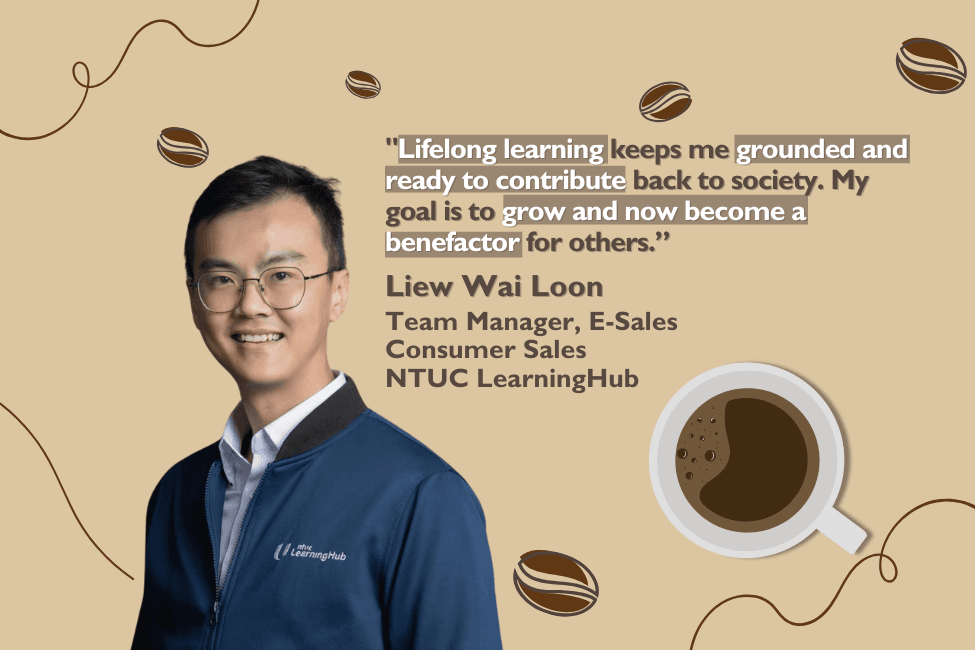
A cup with Liew Wai Loon, Team Manager, E-Sales, Consumer Sales, NTUC LearningHub
By Steven Lee, Brand & Communications, NTUC LearningHub
As I sit down with Wai Loon in a cosy café near NTUC LearningHub (NTUC LHUB)’s main branch, he greets me with a warm smile. His innate zest for life is clear. Even before the conversation begins, what strikes me most is the sense of purpose he exudes — a blend of humility, confidence, and unshakeable positivity.
One of the team leaders in NTUC LHUB’s consumer sales division, Wai Loon’s life is a tapestry woven with threads of adversity, creative pursuits, and an unwavering commitment to lifelong learning.
Sowing the Seeds through Hardship
At the heart of Wai Loon’s journey is his belief in the philosophy of ‘Karmic Seed’, a Tibetan principle emphasising generosity and intentional action. However, his philosophy towards life was not formed overnight.
Wai Loon’s journey began with a series of difficult yet transformative experiences in his early career. Working in a sales and marketing role at a private organisation dealing with the elderly, Wai Loon found himself facing financial stress and job instability in an environment that was not the most conducive for his personal growth.
Despite this, he found meaning in supporting the vulnerable who relied on him, which gave him a sense of purpose. With colleagues being laid off, Wai Loon persevered, even travelling to expand the organisation’s business overseas while grappling with uncertainty.
Rather than becoming disheartened, Wai Loon chose to reflect on his actions and decisions, believing that every challenge was a lesson in growth. His belief in planting good seeds for the future kept him going.
These reflections led him to a profound understanding: he wanted to channel his efforts toward empowering others. Inspired by the ‘Karmic Seed’ philosophy, the principle of ‘helping others to achieve what you want for yourself’ resonated deeply with his own struggles and successes, shaping his professional and personal relationships.
This eventually inspired his transition to NTUC LHUB, where he could help workers through learning and skill development—a mission that aligned perfectly with his values.
“Whatever I want, I help someone else get it first. Whatever I don’t want, I stop doing it to others,” Wai Loon shares. “种子开花了,” he quips, which means, “the seeds have blossomed.”
Blossoming into a New Role
One of the most memorable experiences for Wai Loon was the guidance he received early in his journey at NTUC LHUB. His supervisor, recognising his potential, provided him with guidance on navigating the complexities of his role. Through candid feedback and unwavering support, Wai Loon’s supervisor helped to build his confidence and refine his leadership abilities. “It wasn’t just about giving me advice,” Wai Loon recalls, “but about having someone believe in me and invest their time to help me grow.”
These seeds flourished as Wai Loon advanced through the ranks, first as deputy team lead and eventually as team lead in 2022. Inspired by the guidance he received, Wai Loon embraced his new responsibilities with a commitment to nurturing and empowering his team. Hence, he enrolled in the International Coaching Federation (ICF) accredited Khrysalis coaching courses offered by NTUC LHUB. Through these courses, he honed skills such as active listening and powerful questioning.
By applying these skills, Wai Loon fostered an environment of trust and collaboration within his team. He enabled his colleagues to achieve their goals, creating a culture where everyone felt valued and supported. His efforts translated into tangible improvements in team performance and morale, underscoring his commitment to lead with empathy and purpose.
Wai Loon recalls one rewarding experience, Part of our role is to guide customers through the course registration process, Wai Loon explained. At one point, my team was overwhelmed by the volume of feedback and queries. Having faced a similar challenge when I first started, I stepped in to offer support." Through patience and steady guidance, he helped his colleagues gain clarity and confidence to excel at work. Witnessing their growth was a defining moment for Wai Loon, reinforcing his philosophy of life.
From Content Creation to Workflow Automation
Outside the office, Wai Loon’s is an avid outdoor enthusiast, finding joy and rejuvenation in nature. His creative spirit shines brightest through his YouTube channel. Inspired by a seminar he attended for YouTube creators, he believes in the idea that small, consistent efforts can lead to significant outcomes eventually. “If a single video touches the life of one person, imagine the meaningful impact 1,000 videos will have,” Wai Loon mused.
What started as a platform to share his interests grew into a space where he honed valuable technical skills, such as video editing and storytelling. These experiences fuelled his curiosity about technology’s potential to create meaningful connections and solutions.
Eager to leverage his creativity, Wai Loon pursued a Workflow Automation course, also offered by NTUC LHUB. This newfound expertise allowed him to streamline work processes, improve team efficiency, and enhance customer experience. By automating repetitive tasks with the use of new technology tools like Microsoft Copilot and Power Automate, Wai Loon freed up time for his team to focus on engaging customers with purpose and delivering more personalised interactions. This helps to ultimately drive sales for the company.
Together with the team, Wai Loon’s efforts culminated in NTUC LHUB’s recent wins at the 24th Contact Centre Association of Singapore (CCAS) International Contact Centre Awards.
Collaborating closely with his teammates, Wai Loon was instrumental in producing, editing, and overseeing the award submission video, which was crucial in showcasing his team’s accomplishments. His ability to craft a compelling narrative through visuals and storytelling highlighted the organisation’s commitment to excellence in customer service and sales.
A Journey of Inspiration
From fellow colleagues and supervisors who supported his growth, he cherishes every guiding light that has illuminated his path.
“Lifelong learning keeps me grounded and ready to contribute back to society,” Wai Loon reflects. “I’m lucky to have met many guìrén—benefactors—who have helped me. I need to pay forward what I have received from my previous and current supervisor. My goal is to grow and now become a benefactor for others.”
This mindset drives his passion, shapes his leadership style, and fuels his relentless pursuit of growth. Wai Loon’s journey is a reminder that by aligning passions with purpose, embracing lifelong learning, and cultivating a spirit of gratitude, we can all achieve meaningful success.
As I wrap up my conversation with Wai Loon, I cannot help but feel inspired by his infectious outlook towards life. His story is a powerful example of how passion and purpose can transform not just one’s own life, but the lives of those around them. In his own words, “To succeed, go all out, keep it simple, and charge forward!”
Reach out to our Skills Consultants to find out more about how you can transform your life through learning today!
"You Might Like This
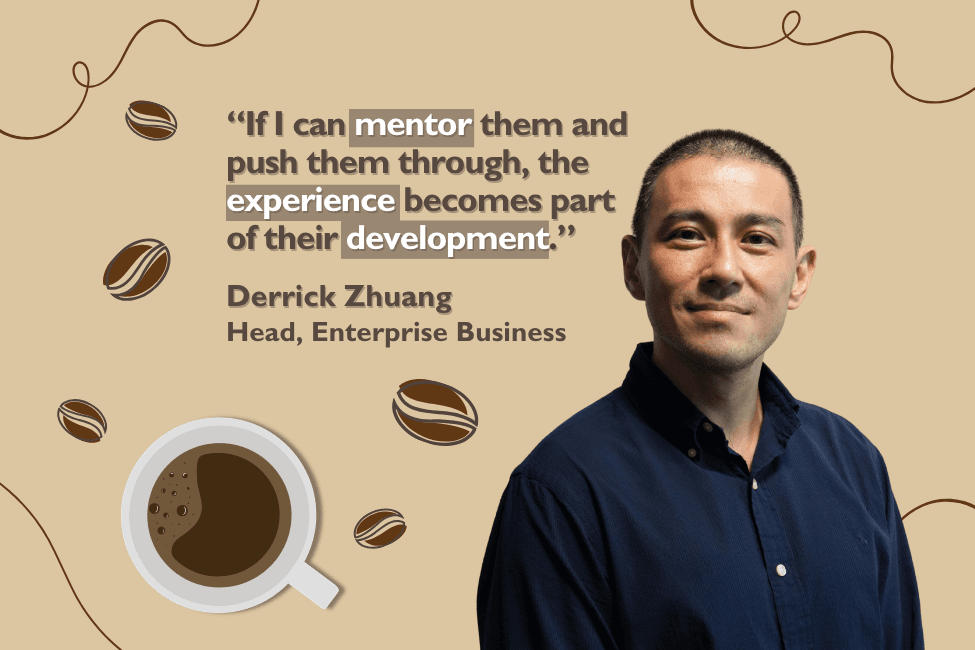
Kopi with LHUBBERS – The Quiet Art of Connecting the Dots
A cup with Derrick Zhuang, Head of Enterprise Business, Corporate Sales, NTUC LearningHub By Steven Lee, Brand & Communications, NTUC LearningHub When I sat down with Derrick Zhuang, Head of Enterprise Business, Corporate Sales at NTUC LearningHub, over kopi, the first thing that struck me was how calm he was. Measured. Thoughtful. Composed. Derrick carried himself with a quiet confidence. He listened carefully, paused before answering, and seemed more interested in understanding than racing to fill the silence. His was the kind of presence that put others at ease, one that relied less on being the loudest voice in the room and more on paying close attention to what was being said. As our conversation unfolded, that observant nature began to make more sense. It shaped not only the way he connected with people, but also the way he approached his work and, perhaps more importantly, the way he leads. Where the Pieces Came Together Long before Derrick entered the world of sales, the foundations of how he thinks were already taking shape at the National University of Singapore, where he majored in History. History demanded more than remembering dates and events. It meant reading widely, weighing competing perspectives, questioning assumptions, and piecing together information to understand the bigger picture. For Derrick, it cultivated an early respect for context, critical thinking, knowledge and the discipline of looking beyond a single piece of source before drawing conclusions. It was perhaps a natural progression, then, that he began his career in military intelligence where research, information gathering and analysis became part of his daily work. Different data points had to be assessed, patterns identified, and signals connected to form a clearer picture of what was happening. But Derrick's military years left him with another lesson too: one that had less to do with information and more to do with people. Looking back, he admits there were times when he felt he could have given more of himself. Yet what stayed with him was not his own shortcomings, but how the commanders and mentors around him responded. Rather than writing him off, they were patient. They continued to guide him and invest in his development. The experience left a lasting impression. Years later, whenever Derrick thinks about leadership, he returns to that same principle: people do not always arrive fully formed. Sometimes leadership means seeing what someone could become and giving them the time, support, and opportunity to get there. Finding His Place in Sales Derrick did not move directly from the army into the career he has today. For a brief period, he tried something quite different, earning himself a real estate agent license. The experience gave him his first taste of sales, and more importantly, a clearer sense of the kind of impact he wanted to make. He soon realised he was drawn not just to individual transactions, but to solving broader business challenges. That eventually led him into business-to-business (B2B) sales. Derrick's first B2B role took him into an interior design firm and a commercial world he knew little about. It was another steep learning curve. He describes becoming a kind of “linker” between corporate sales and other parts of the business: picking up the language of the industry, understanding how different functions connected and learning enough to make sense of what clients were trying to achieve. And once again, someone more experienced helped show him the way. His boss had spent years in the field and shared frameworks and principles that went beyond simply closing a sale. Derrick learnt how to understand a client, how businesses operate and how experience gradually sharpens judgement. “With information, knowledge, and experience, certain instincts can be trained,” he reflects. Over time, Derrick began to see that B2B sales were about far more than products or contracts. It was about understanding an organisation's goals, connecting different pieces of the puzzle and helping businesses move forward. In many ways, he had found his calling. More than a Training Conversation That path eventually brought him to NTUC LearningHub. When Derrick joined, his work centred on strategic accounts spanning different domains. Working across organisations with very different priorities gave him a broader view of enterprise needs. Healthcare would become one of the most meaningful. Derrick found himself working closely with healthcare organisations, helping them identify training and workforce development solutions for their employees. At first, the conversations centred on learning needs and skills development. But over time, Derrick realised that training was often just one part of a much bigger picture. He recalls one discussion that quickly evolved beyond courses and capabilities into questions about staff rostering and patient service. For Derrick, that changed the nature of the problem. A roster was not just something to optimise; it affected whether the right people were available to care for patients. Patient service, too, had a human story behind it. “You need to understand the industry,” he says. In healthcare, that meant looking beyond the training solution to understand the operational realities, the people affected and how new capabilities could genuinely support the work. “Meaningful solutions begin with understanding the realities businesses face and the people affected by them,” Derrick explains. For the first time, he could see how helping an organisation transform was about much more than meeting business objectives. The decisions made within a company could ultimately shape the experiences of employees, customers and communities. It was a perspective that would stay with him even till this day. Coming Full Circle As Derrick accumulated more experience, another part of his journey began to come full circle. Having benefited from mentors throughout his career, he wanted to play that same role for others. He proudly speaks of colleagues whom he has watched grew from capable Account Managers into seniors who now guide newer team members. To Derrick, that is one of the most rewarding parts of leadership. His advice to younger colleagues is simple: “It's never wrong to ask questions.” But he does not want them simply to look upwards for answers. Over time, he wants them to recognise the right questions—the ones that help them understand the problem for themselves. That also means allowing people room to try, stumble and learn. Mistakes will happen, particularly when someone is pushing beyond what is familiar. What matters is what happens afterwards. Why did it happen? What did you miss? What would you do differently next time? “If I can mentor them and push them through,” Derrick says, “then the experience itself becomes part of their development.” Understanding People, On and Off the Clock It is perhaps unsurprising that becoming a father has reinforced that belief. To Derrick, leadership and parenting share a similar responsibility: understanding the individual in front of you. The role of a parent, or a leader, is not to force everyone down the same path, but to recognise what people need, nurture what they are good at and help them realise their potential. Every now and then, even Derrick needs to “switch off”. He enjoys football, singing, and time with his family. A Liverpool supporter whose son now plays the game, he finds these moments provide a welcome change of pace from thinking about work. Yet his fascination with people never entirely switches off. Whether it is the psychology behind his favourite films such as The Wolf of Wall Street and Catch Me If You Can, or the lessons he continues to carry from his past experiences, he remains curious about what motivates people and shapes their decisions. And when asked whom he would invite to dinner if he could choose anyone, past or present, Derrick does not name a celebrity, business icon or football legend. He chooses his former army commanders. The reason is simple: to thank them. Years after they patiently guided a younger Derrick through a period when he felt he had not always given his best, the gratitude remains. Perhaps that answer says as much about Derrick as anything else. By the end of our conversation, his calm, measured presence made perfect sense. History taught him to value context. Military intelligence taught him to read data. Sales taught him to understand people. Leadership taught him to pass those lessons on. The thread running through it all is simple: gather the information, understand the context, connect the dots, and help others do the same.
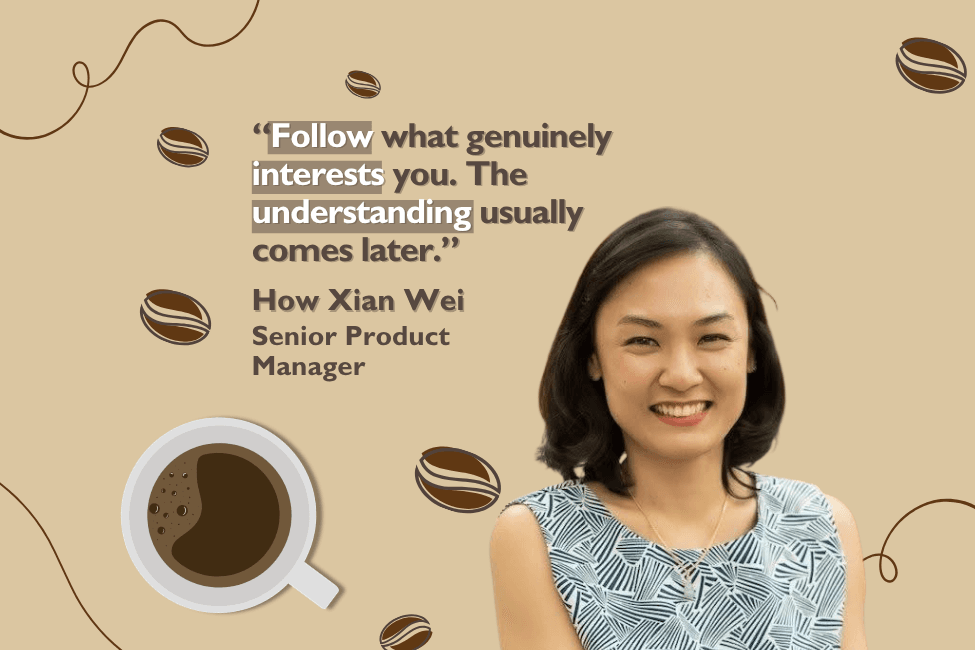
Kopi with LHUBBERS – Turning Curiosity into a Career
A cup with Xian Wei, Senior Product Manager, Business and Digital Skills, NTUC LearningHub By Steven Lee, Brand & Communications, NTUC LearningHub Xian Wei is the kind of person who listens to understand, not just to reply—turning even an interview into a genuine exchange. Over kopi, she quietly flipped the dynamic, asking thoughtful questions of her own. It was a small moment that revealed her attentiveness and curiosity. Xian Wei is a Senior Product Manager at NTUC LearningHub, where she oversees a suite of courses tied to Human Resources (HR) and people-related skills. But behind the job title is someone whose real fascination lies somewhere deeper. "There’s always been one thing I keep coming back to, she says. Understanding people. Why they do what they do, what drives them, and how they find their way to work that truly aligns with who they are.” Her career, on paper, looks like a constellation of unrelated points: technology solutions consulting, automotive, financial consulting, a mental fitness startup, and now adult education. But after sitting down with her, the lines begin to connect. Every chapter was its own quiet study of human behaviour. The Making of a Curious Mind Xian Wei graduated from the National University of Singapore with a degree in Communications and New Media, at a time when social media was just beginning to take off. Her initial career path, however, had little to do with communications. She joined a car dealership and was eventually promoted to the regional office covering Southeast Asia over the years. It was a steep learning curve, but one she remembers fondly. "I really had fun there, she says. But I've always had this instinct to keep growing, and exploring what else is out there. So when the right moment came, I took it." What followed was a stint in full-commission financial consulting: a sales-driven environment that gave her an early, visceral understanding of how motivation shapes human behaviour. "That experience taught me a lot about what makes people tick, she reflects. It was an intense season, and one she does not romanticise. But looking back, she recognises it as the first time she began paying close attention, not just to clients and targets, but to the underlying psychology of why people behaved the way they did under stress. After leaving financial consulting, it was not long before a different kind of opportunity found Xian Wei. She joined a small startup built around a mental fitness app, working alongside a founder whose background was in neuroscience. Together, the founder combined hard science with positive psychology, creating a profiling tool that helped people understand their own behavioural patterns, grounded in how the brain processes thought and emotion. It was her first real glimpse that the mind could be studied rigorously—and applied to genuinely improve lives. Almost by accident, she had found the closest thing to her true calling. “That’s when it clicked,” she says. “I wasn’t just interested in sales, marketing or strategy. I wanted to understand why people behave the way they do, and how that insight can optimise their talent in life, especially at work.” However, this chapter came to a natural close, as she felt it was time to pursue a different direction. It became an opportunity for her to explore a new path, but her first time stepping away from a stable job role. "It felt like forever, she says of the few months that followed. Every day felt uncertain. But looking back, it gave me time to reflect and rediscover myself, and where my aspirations were." Landing and Learning at NTUC LearningHub When NTUC LearningHub was looking to fill a product manager role focused on HR-related courses, Xian Wei's background did not tick the conventional boxes. But what she lacked in formal HR experience, she made up for through a sharp instinct for people and what drives them. "I had no experience as a product manager, she admits. A lot of it, I had to learn from scratch." She discovered quickly that HR was not the simple, administrative function it is often assumed to be. "Everyone thinks they know HR because they've experienced onboarding or benefits as an employee, she says. But understanding what actually motivate people to be productive is a completely different skill." Now in her fouth year, Xian Wei has grown increasingly invested in the bigger question: how do you help people discover what they are genuinely good at, rather than what they have simply fallen into? "If a team already knows their individual strengths, who's great at strategy, who's better at execution, who naturally leads, that's when one plus one becomes far more than two, she explains. It is this continuous interest in human potential that eventually led her back to the classroom but this time, as a student. Where Psychology Meets the Stars Xian Wei is undergoing a Master's degree program in Industrial-Organisational Psychology, known in some parts of the world as Work Psychology, a field dedicated to understanding human behaviour within organisations. "I wanted to go deeper, she says simply. Singapore is already trying to find the right jobs for people. I want to help people find out what their interests actually are, because I believe if you have a genuine interest in something, the skills will follow naturally." She likens her own journey to the well-known story of Steve Jobs, who once attended a calligraphy class with no clear purpose in mind, only for that seemingly unrelated skill to shape the typography of the first Macintosh more than a decade later. "I didn't always know why I was doing what I was doing, she says. But looking back, I can see how trusting my curiosity would help." "It's not about being defined by a company or a job title, she says. It's about helping people define themselves." Xian Wei's fascination with human behaviour does not stop at formal psychology. In her own time, she has also become interested in astrology and family constellation: practices she approaches not as fixed predictions but as another language for the same questions she has spent her career circling. "I don't see it as 'this will definitely happen to you', she clarifies. I see it more as references. It's a way of looking at patterns: your tendencies, your blind spots, what you naturally gravitate towards. Then it's still entirely up to you what you do with that information." She now reads birth charts for friends, family, and by her own cheerful admission, even her pet hamster, purely for fun. "A birth chart is really just a snapshot, she explains. It's a way of organising a lot of different traits and tendencies into something you can actually reflect on. The houses represent different areas of life, the planets represent different qualities, the zodiac signs represent the clothes of the planets’ qualities. Where all of them sit can tell you something about how a person naturally shows up in the world." What draws her to it, she says, is not so much the mysticism, but the structure it offers for self-reflection, very much the same draw that pulled her towards psychology and behavioural profiling in the first place. "Through this, I actually noticed certain patterns in myself, she shares candidly. Like a tendency to want to empathise with others, to solve their problems, and sometimes to my own detriment. Once I became aware of it, I could choose differently." It is this same instinct, turning a tool for self-understanding into instruments for self-improvement, that runs through everything she does, whether it is a formal psychometric framework, a Master's thesis, or an astrology constellation. "At the end of the day, whether it's psychology, astrology, or just a good conversation, I think it's all trying to answer the same question, she says. Who are you, really? And what creates your law of large happiness?" It is, perhaps unsurprisingly, the same question she is now trying to help others answer through her work at NTUC LearningHub. The Exploration Continues Xian Wei's curiosity does not switch off when she leaves the office. Her hobbies reveal the same exploratory instinct that defines her career, from open-world video games that reward discovery, to contemporary dance moves, which she is preparing to perform in a recital later this year. Perhaps most unexpectedly, Xian Wei once took part in thirteen live improvisational theatre shows and performed in front of a real, ticketed audience. "That was something I did to heal, at a time when I needed it, she says. Improv, she explains, demands complete presence. You cannot plan what to say. You can only listen and respond spontaneously. Towards the end of our conversation, I asked Xian Wei what she would say to someone who feels lost about their career. "You don't always need to know the ‘why’ straight away, she said with a smile. Sometimes you just need to follow what genuinely interests you, even if it doesn't make sense yet. The understanding usually comes later." It strikes me that this is the same philosophy she brings to her own work. Whether she is shaping a course or reading someone’s birth chart over coffee, what might appear from the outside as a scattered set of experiences is, up close, a coherent whole. Whatever the next chapter holds, you sense she will embrace it with openness—curious, clear‑eyed, and unafraid of where it may lead. "
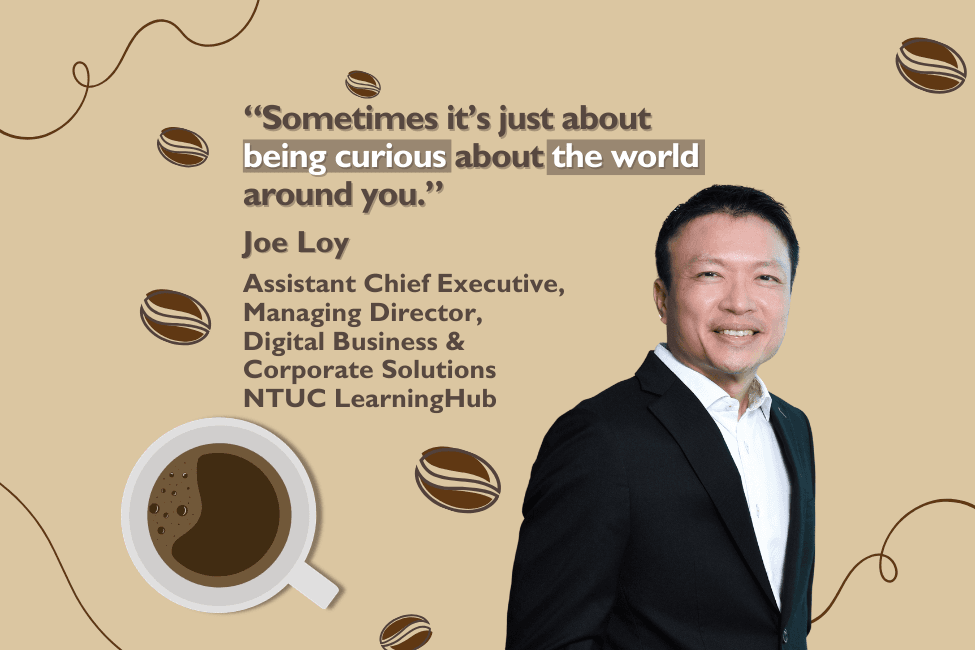
Kopi with LHUBBERS – Beyond Digital: Why People Still Matter Most
A cup with Joe Loy, Assistant Chief Executive & Managing Director, Digital Business & Corporate Solutions, NTUC LearningHub By Steven Lee, Brand & Communications, NTUC LearningHub As I sat down with Joe over kopi, one thing became clear. His passion for technology was never just about a job. It was a quiet, persistent curiosity—one that began long before digital transformation even became a buzzword. Joe is part of the NTUC LearningHub senior management team, where he leads the organisation’s digital business and corporate sales teams. His career stretches across decades and industries from telecommunications, banking, insurance and the wider financial sector. Today, his work unfolds at the crossroads of technology, partnerships and workforce transformation, where progress and evolution are continuous. “There has always been one constant for me,” he says. “Digital.” His journey into the digital world began at a time when the landscape looked very different. “I started before smartphones existed. Before the iPhone. Before Facebook. Back then, when we talked about digital, it meant websites, system integration, and forums.” He chuckles softly. “People used to ask, ‘What’s a forum?’” Back then, what counted as “digital innovation” was far simpler. Yet even in those early days, Joe was fascinated by how technology could reshape the way people worked and communicated. What began as an interest soon became the thread that would run through every stage of his career. Growing Up Digital Starting out in the late 80s and early 90s, Joe entered the workforce just as the internet was beginning to emerge and digital systems were rapidly gaining momentum. Over the years, each career transition brought new challenges. His interest grew as he learnt more about how digital tools and platforms can reshape the way organisations operate. His early years in the startup space taught him important lessons about adaptability and problem-solving. “In a startup, you learn very quickly that things rarely go exactly as planned,” Joe reflects. “You often have to figure things out as you go along.” The experience required resilience and a willingness to experiment—skills that would later prove invaluable as digital technologies continued to evolve. Later, when Joe moved into the financial sector, he found himself navigating yet another new environment. The pace, processes and expectations were different, but the role that digital technology played in shaping business outcomes remained just as, if not more important. Looking back, Joe sees these transitions not as detours, but as valuable experiences that helped him understand how technology evolves and how organisations and people adapt with it. Learning Across Borders Yet for all the technological changes he witnessed across industries over the years, one realisation stayed constant for Joe. “Technology moves very quickly,” he says. “But at the end of the day, it’s still about people working together to solve problems.” That lesson became especially clear during one of the most enriching phases of his career—when he found himself working on a global programme alongside colleagues from more than 20 nationalities. The pace was demanding, but the experience proved rewarding. Working alongside colleagues from Europe, Asia, and other regions exposed Joe to a wide range of perspectives. Beyond technical knowledge, Joe learned how to collaborate across cultures and navigate complex team dynamics. Each team member approached things differently, shaped by their cultural norms and professional experiences. “In some cultures, people are very direct when they communicate. In others, they are more diplomatic or consensus-driven,” he explains. “You learn quickly that there isn’t only one way to solve a problem.” “It was an eye-opening experience,” he says. “Technology connects people, but the work still depends on human relationships.” The Mentor Who Made a Lasting Impact When I ask Joe about defining influences, he doesn’t mention accolades. For Joe, the most important lessons in his career did not come from titles or achievements, but from people who took the time to share their experiences and guide him along the way. In the early 2000s, shortly after joining Hewlett Packard, Joe met someone who would quietly shape his professional approach—an Italian colleague based in the Netherlands. “There wasn’t any formal mentorship programme,” Joe explains. “We just happened to work on similar projects and travelled frequently together.” But the senior colleague noticed that Joe was new and navigating a large organisation for the first time. “He had already been in the company for more than ten years,” Joe says. “He understood the culture, the processes, and how things worked.” Gradually, he began offering guidance. Sometimes it was practical advice about how to navigate projects and internal systems. At other times, it was simply a perspective on how to approach challenges. Those conversations helped Joe acclimatise to a new corporate environment that might otherwise have felt overwhelming. Early in his career, Joe’s mentor played a key role in guiding him through moments of uncertainty, encouraging him to step back and reflect on the motivations and priorities of different stakeholders. “That changed how I approached challenges,” Joe says. Those small shifts in perspective gradually helped him grow more confident in navigating large organisations and complex projects. “When you’re new, you sometimes second-guess yourself,” Joe says. “Having someone more experienced to talk to makes a big difference.” Over time, the professional relationship evolved into a genuine friendship. “When you travel together frequently, you naturally get to know each other beyond work,” Joe says. Even today, they remain in touch. Looking back, Joe believes the mentorship played an important role in shaping how he views leadership today. “It showed me how valuable it is to share experiences with others,” he says. Paying the Lessons Forward Those early experiences are one reason Joe believes strongly in mentoring younger professionals today. “I was fortunate to have someone guide me when I started out,” he says. “So naturally, I feel it’s important to do the same for others.” At NTUC LearningHub, this philosophy aligns closely with initiatives like the Career Mentorship Programme (CMP), which connects experienced professionals with individuals seeking guidance in their careers. Joe sees mentorship not as a formal obligation, but as a meaningful exchange. “When people first start working, they often have many questions,” he says. “They’re figuring out what direction they want to take.” “Sometimes all it takes is a conversation with someone who has walked a similar path.” Joe believes mentorship can shorten the learning curve for younger professionals. “If someone can avoid a few mistakes and reach their goals sooner because of guidance, that’s valuable.” Just as his own mentor once helped him navigate unfamiliar environments, Joe now hopes to offer that same support to the next generation. “Mentors will appear at different stages of your career,” he says. “The important thing is to stay open-minded and learn from them.” Learning Beyond the Office Outside of work, Joe’s approach to life mirrors the same philosophy that has guided his career—learning never really stops. “I read quite a bit,” he says, though he is quick to clarify that he does not mean reading thick books cover to cover. Instead, Joe prefers absorbing information in small, consistent ways. He regularly reads articles across business, finance and technology through platforms that curate news based on his interests. “These small pieces of information help me keep up with what’s happening,” he explains. “You pick up something new here and there.” For Joe, learning does not have to come from formal training programmes or structured courses. “People sometimes think learning means attending a three-day course,” he says. “But what happens in between?” His belief is simple—small efforts add up over time. “Learn one or two things this week. Next week, learn another one or two. Over time, it accumulates.” Consistency, he believes, is the key. This mindset extends naturally into how Joe spends his time outside work. He enjoys wine and dining with family and friends, not for the prestige of fine restaurants, but for the experience of spending meaningful time together. “The best dining experiences are really about the company,” he says. Joe makes a conscious effort to keep those moments free from distractions. “If you take the time to meet someone, you should make the time count.” For him, shared meals are opportunities to reconnect, to talk, exchange ideas and learn from one another’s experiences. Travel is another way Joe enjoys learning outside the office. He values taking trips with his children whenever possible, seeing it as a chance to both explore new places and spend time together. One particularly memorable trip brought the family to Abu Dhabi, where they visited the Sheikh Zayed Grand Mosque. “My kids enjoyed it a lot,” he recalls. “Travel is also a chance to learn more about each other.” Even activities like running, something Joe used to do regularly in the early mornings, reflect the same philosophy of consistency. Whether it is staying active, reading widely or sharing conversations over meals, Joe believes these everyday habits help keep the mind open and engaged. <p style="text-ali